Type of pants/jeans to look for
When doring the back piece adaptation (to create an angle for seated position) it is extra important to choose the right type of pant to adapt:
Dress pants generally come in fairly similar styles. Try to find a pair that rides medium to low on the waist. Avoid high waisted style pants and pleating in the front.
With jeans, we got the best results when using medium to low riding jeans in stretch denim. Avoid high waisted jeans for this adaptation
Tools needed
You will need scissors, and unpicking tool, cheap white non stretch cotton or calico (available from fabric stores or Ikea) A tape measure, a ruler, marking pens, chalk fabric markers, pins, hand sewing needles and thread, suitable fabric and a sewing machine. For the “hook and eye” adaptation you will need a hook and eye set. For the fly adaptation you will need a Zip. For “ROUND” body adaptations you will need elastic and a large safety pin.
The fit is important
How the jeans fit pre adaptation is important to how they will fit post adaptation (particularly important for adaptation of the back piece). Ill fitting pants will not improve from adaptations (though a slightly looser fit will be more successful than trying to adapt a pair of jeans or pants that are already too small). Try your pants or jeans before you adapt them, in a laying down position and sitting up.
When trying them while laying down, look for a pair that fits well over the hips and waist. You’re better off leaning towards a waist that is slightly loose, meaning you are able to easily slip a finger between the skin and the waist band. When sitting up, un-adapted jeans and pants will cut into the waist and belly at the front. If they are cutting in excessively, or you can’t do them up in sitting position, then you need a larger size.
Understanding pants/jeans sizes
Pants and jeans can come in several variations of sizing: Pants can come sized in letters or numbers for example 32, 34, 36 or XS, S, M. Jeans can be sized in dress sizes for example 32, 34, 36, or XS, S, M or inch sizes, for example 26”, 27”, 28”. For a more comprehensive view of sizing, and to find out what size you are, see the MEN’S and WOMEN’S SIZING information.
NOTE! For our back adaptations you will need to know your pants/jeans size and which size – S, M, XL, XL, XXL – we have alotted them.
Click here to go directly to information on MEN’s pants sizes.
Click here to go directly to information on WOMEN’s pants sizes.
Types of adaptations
In this section you will find a number of smaller adaptations like knee tucks, adapted flies, button replacement and pocket adaptations. While these are useful and certainly make pants more functional in many cases, our main adaptations focus on creating a different angle between legs and top part of pants fitting a seated position. This is done by removing and replacing part of the back piece of the pants.
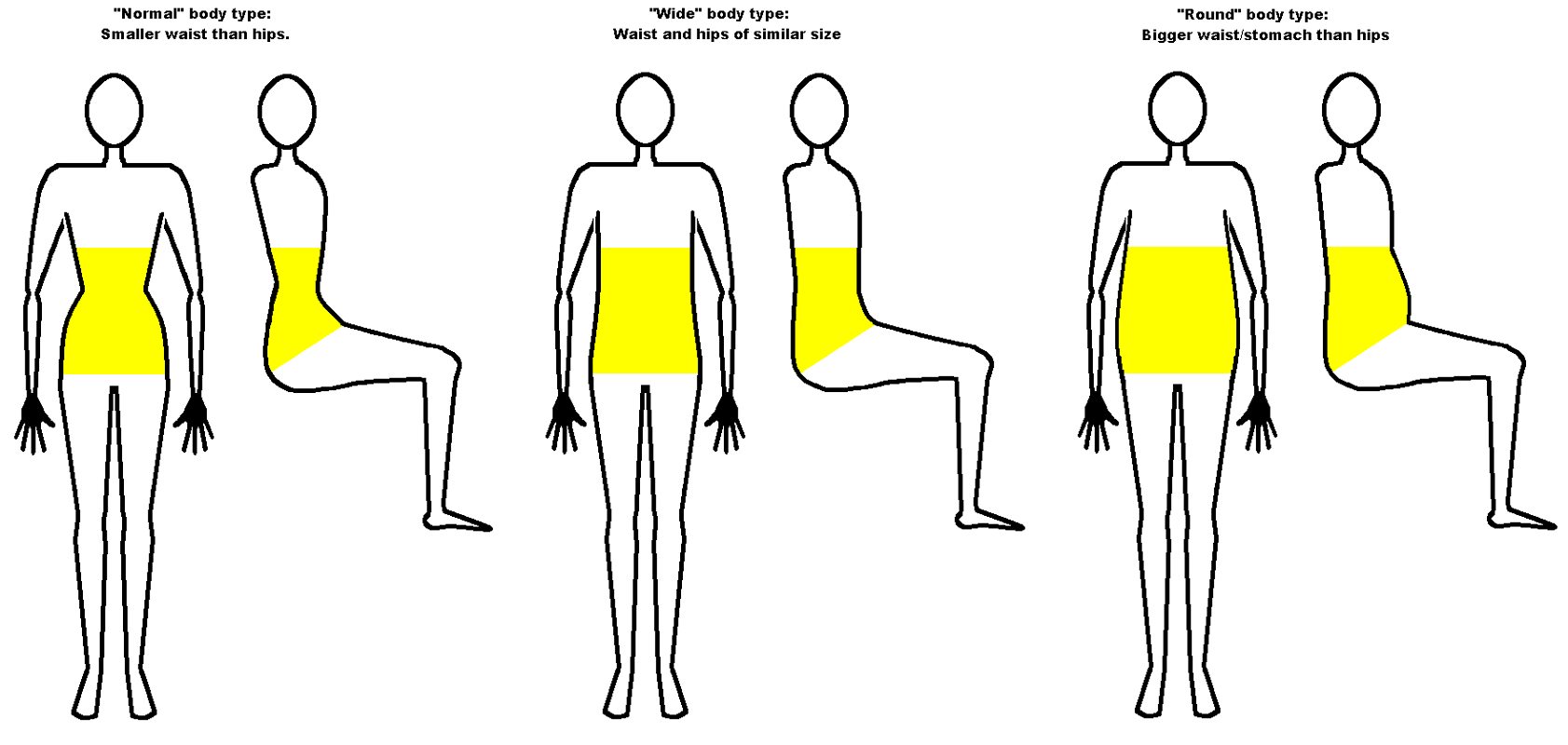
Depending on your body type you can choose from 3 types of back piece adaptations:
“NORMAL” – which refers to a body shape that has traditional proportions with a waist that is smaller than the hips.
“WIDE” – which refers to a body type where the waist is similar in size to the hips.
“ROUND” – which is when you have a bigger waist and stomach area than hips.
If you are undecided between the “NORMAL” and “WIDE” adaptation, it is recommended that you do the wide adaptation first as this requires no cutting of the waist band. If you find it too big it is easy to replace the adaptation piece with a “normal” adaptation piece. The adaptation for the “ROUND body type removes the waist band and replaces it with an elasticised one.
Type of fabric
Any fabric can be used, depending on your sewing skills though the samples done in this project were all done in cotton or stretch denim. You can try finding fabric’s that match the fabric of you garment, or alternative you can stick with plain black or white or choose a patterned or coloured fabric for a bit of fun and flair. Stretch fabrics can be used, but take care with them as they can be slightly more difficult to work with. Only non stretch fabrics are recommended for the fly adaptation.
WHAT TYPE OF PANTS AND JEANS TO LOOK FOR?
Dress pants generally come in fairly similar styles. Try to find a pair that rides medium to low on the waist. Avoid high waisted styles and pleating in the front.
With jeans, the best results were seen from medium to low riding jeans in stretch denim. Avoid high waisted jeans for this adaptation
WHAT DO YOU NEED?
You will need scissors, and unpicking tool, cheap white non stretch cotton or calico (available from fabric stores or Ikea) A tape measure, a ruler, marking pens, chalk fabric makers, pins, hand sewing needles and thread, suitable fabric and a sewing machine. For the “hook and eye” adoption you will need a hook and eye set. For the fly adaptation you will need a Zip. For “ROUND” body adaptations you will need elastic and a large safety pin.
THE FIT IS IMPORTANT
How the jeans fir pre adaptation is important to how they will fit post adaptation. Ill fitting pants will not be improved with an adaptation, though a slightly looser fit will be more successful than trying to adapt a pair of jeans or pants that are already too small. Try your pants or jeans before you adapt them, in a laying down position and sitting up. When trying them while laying down, look for a pair that fits well in the hips and waist. You’re better off leaning towards a waist that is slightly loose, meaning you are able to easily slip a finger between the skin and the waist band. When sitting up, un-adapted jeans and pants will cut into the waist and belly at the front. But if they are cutting in excessively, or you can’t do them up in sitting position, then you need a larger size.
WHAT SIZE?
Pants and jeans can come in several variations of sizing: Pants can come sized in letters or numbers for example 32,34,36 or XS, S, M. Jeans can be sized in dress sizes for example 32,34,36, or XS, S, M or inch sizes, for example 26”, 27”, 28”
For a more comprehensive view of sizing, and to find out what size you are, see the MENS and WOMENS SIZING information.
WHAT TYPE OF ADAPTATION?
Depending on your body type you can choose from 3 adaptation types: Type one is called “NORMAL” this refers to a body shape that has traditional proportions of a waist that is smaller than the hips. Body type two is “WIDE” this refers to a body type where the waist is similar in size to the hips. The third body type is “ROUND” this is when you have a bigger waist and stomach area than the hips. If you are undecided between the “NORMAL” and “WIDE” adaptation, it is recommended that you do the wide adaptation first as it requires no cutting on the waist band, if you find this too big, then it is easy to replace the adaptation piece with the “normal” adaptation piece. The adaptation for the “ROUND body type removes the waist band and replaces it with an elasticised one.
Please see the “BODY TYPE” information for visual reference.
WHAT FABRIC?
Any fabric can be used, depending on your sewing skills though the samples done in this project were all done in cotton or stretch denim. You can try finding fabric’s that match the fabric of you garment, or alternative you can stick with plain black or white or choose a patterned or coloured fabric for a bit of fun and flair. Stretch fabrics can be used, but take care with them as they can be slightly more difficult to work with. Only non stretch fabrics are recommended for the fly adaptation.


I am searching for information about adaptive clothing. My son is an army veteran who was injured and is now double amputee. He has been wearing cargo shorts and is trying to step into pants with his prosthesis. He sometimes cannot wear pants because they are not fitted properly for him to pull over the prosthetic. Cargo shorts are great but the shorts gain a lot of wear and tear from the prosthetics use a lot of small holes where friction is concerned. I am looking maybe to cut pants off at the knees and putting in a zipper to zip on pants legs. or does anyone know of a company who make these type of clothing already?
Sherry, there’s quite a lot of pants out there with lower pants legs possible to zip off and on. I did a search on google using the words – zip off pants – which threw up a nice assortment of pants types and place of zip off/on.
https://www.google.com/webhp?source=search_app#q=zip%20off%20pants
We’ve looked at pants like this as they are nice – already adapted – pants, with great use. I’m actually planning to write a blog about them later in the year (my to-do-list is a bit piled up at the moment :-)).
While these are pants of more leisure wear/everyday types he might also want to have some nicer pants for special occasions which can be hard to find as zip offs. An alternative to at least solving any problem with stepping into the pants could be to sew in zips along the side seams – from hem up to knee (or further if needed). Unfortunately we don’t have any sewing instructions up for this but there’s a really easy way to put in zips behind seams. Basically, you sew the zip onto the seam (inside of garment) – being careful to put the zip exactly with the seam running along its middle. After sewing it you then un-pick the seam to uncover the zip.
You can look at sewing instructions for non-stretch skirts where we’ve actually done instructions on how to sew zips along the seam line. Makes me feel a bit stupid now, why we’ve not shown it as a general instruction for zips. *making mental note*
http://en.fashionfreaks.se/patterns/skirts/sewing-instructions-non-stretch-skirt/insert-zips-and-sewing-together/
We’ve actually talked early on about zips in seams as a solution but must have slipped back in the mind.
http://en.fashionfreaks.se/adapting-ready-made-clothes/simple-adaptions/jackets-pants-zips/
As you see on pic at end of page putting them in side seams is a solution.
Of course this does not solve the problem with wear and tear but it’s nice sometimes to just look good.
Hope this is of some help.
Susanne
XXL Husband has ALS and “lives” in his wheelchair. Because breathing is compromised he cannot sleep in a bed. Also as his abdomen muscles and legs do not work he cannot stand nor walk. I can sew and need pants that I can pick him up with a mechanical lift in a sling that still allows him to toilet in a bucket slipped beneath him. Any ideas would be welcome. Currently he lives in big stretchy cotton shorts.